

Agents

Agents use models, prompts, and tools to complete tasks in Etals.
View as Markdown

An agent is responsible for completing a specific task in Etals.

Each agent is powered by a model, guided by one or more prompts, and can be combined with other agents in pipelines.

When your environment is created, Etals automatically sets up agents for common use cases.

These are examples of agents that are created:

AgentWhat it is used for
CopywriterWrites product copy, SEO content, marketing text, and other customer-facing content.
TranslatorTranslates content into the target language while following brand, market, and language rules.
Translator validatorReviews translated content to check quality, consistency, and rule compliance.
Master data specialistWorks with structured data, such as product properties, categories, options, and enrichment tasks.

Managing agents

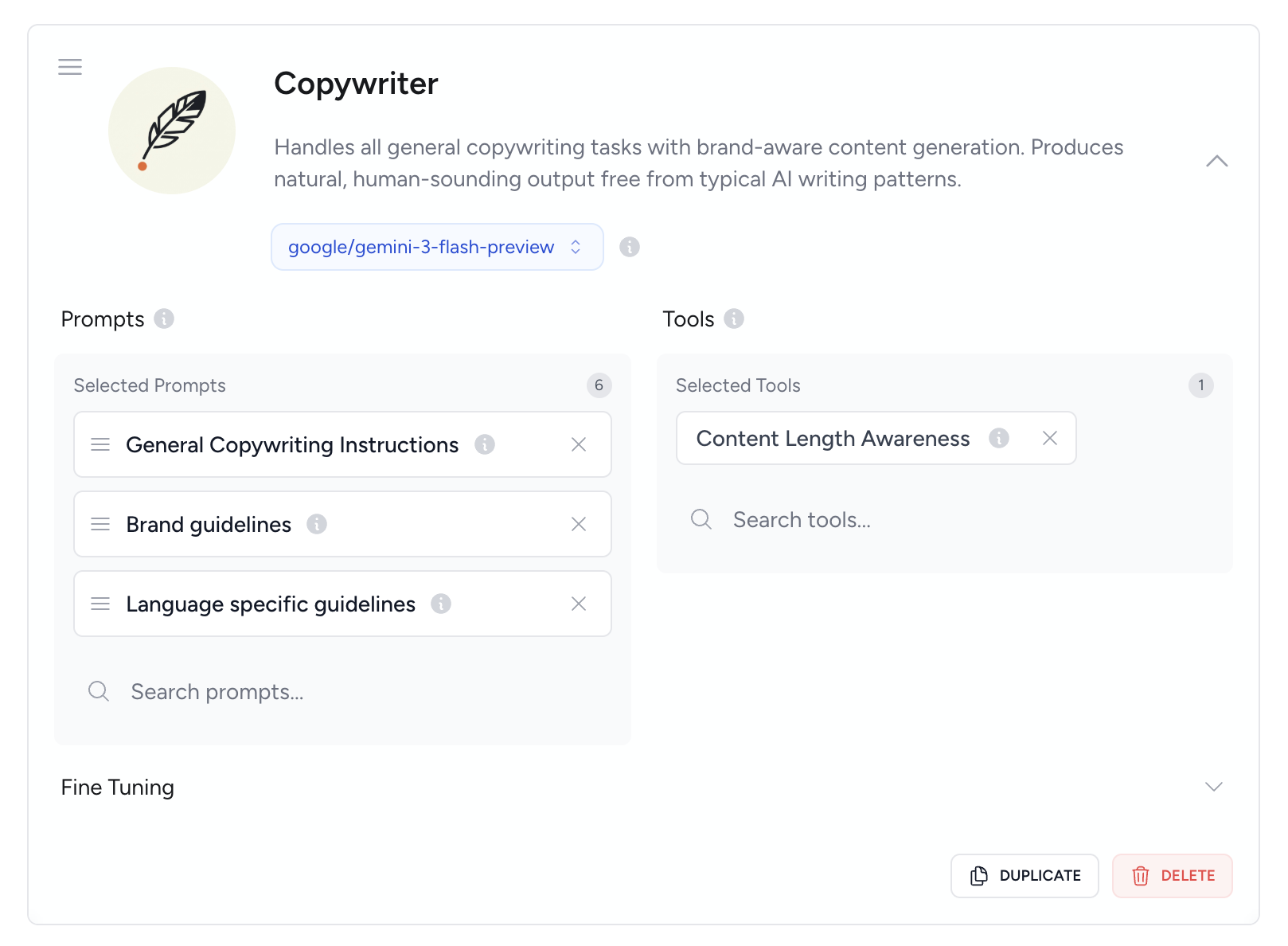
To manage agents, open the main navigation and go to Library > Agents.
image

Models

You can change which model powers an agent from the model dropdown.

Different models can be better suited for different tasks. For example, one model might be better for creative writing, while another might be better for validation or structured data work.

Agents created automatically by Etals use best-practice models for their use case, balancing output quality, speed, and cost.

Prompts

Prompts tell an agent what to do and how to do it.

Prompts can be shared between agents. This is useful when several agents need the same information, such as brand guidelines, language rules, or market-specific instructions.

You can attach prompts to an agent from the prompt management section.

We recommend that each agent has:

  • One main prompt that explains the task.
  • Supporting prompts that add context, such as brand guidelines, language rules, or product-specific instructions.

Tools

Tools extend what an agent can do.

For example, a copywriter might need to search online, check text length for SEO fields, or look up keyword volume in a specific market. If an agent has access to a tool, it can use that tool when completing its task.

You can add tools to an agent from the tool management section.

Available tool choices

Tool choiceWhat it does
Agent MemoryLets an agent remember important observations, preferences, decisions, and patterns between runs. The agent can read and update its own memory.
Search onlineLets an agent search Google for web results, local business listings, and shopping results. Useful for research, competitor checks, and market context.
Find TrendsLets an agent analyze keyword popularity and search interest over time with Google Trends. Useful for seasonal patterns and emerging topics.
Find and manage my dataLets an agent find and retrieve records from your Etals data, such as properties and property values.
Content Length AwarenessLets an agent measure text length by character count and SERP pixel width. Useful for meta titles, meta descriptions, and other length-sensitive content.
Todo ManagementLets an agent create and update todo items, including generating action items from completed audits.
SEO InsightsLets an agent fetch SEO data from Google Analytics, Google Search Console, and Google Ads, then write structured SEO insights.
Crawl one or more pagesLets an agent fetch and analyze web pages for a specific focus, such as SEO checks, content audits, competitive analysis, or data extraction.
Send EmailLets an agent send ETALS-branded emails to one or more recipients.
Google Search ConsoleLets an agent analyze Search Console data for a domain, including clicks, impressions, CTR, rankings, opportunities, and query trends.
Read RSS FeedLets an agent read RSS or Atom feeds. Useful for monitoring industry news, competitor content, and other syndicated sources.
Keyword RankingsLets an agent check Google rankings for keywords in a country and see the top organic results.

Using tools can increase the cost of running an agent.